
Plenty of Bucks County venues allow dogs at the ceremony; far fewer allow them at the reception, and the difference matters. The question to ask isn't "are you pet-friendly" — it's "where, for how long, and under what conditions."
The three levels of "pet-friendly"
Grounds and photos only. The dog comes for portraits before or after, then leaves. The most commonly permitted, and honestly the version that works best.
Ceremony. The dog walks down the aisle or waits with the wedding party, then goes home. Widely permitted at outdoor venues.
Full event including indoors. Rare. Health codes around food service make this genuinely difficult for venues with kitchens, regardless of how they feel about dogs.
What to ask a venue
- Are dogs permitted, and where specifically?
- Indoors, outdoors, or grounds only?
- Is there a fee or a deposit?
- Do you require proof of vaccination or insurance?
- Are there areas that are off-limits?
- Is there somewhere shaded and quiet for the dog to wait?
- Is there water access and somewhere for a bathroom break?
- Have you had dogs at weddings before, and how did it go?
That last question is worth asking. A venue that's done it before has a routine. A venue that hasn't will improvise on your wedding day.
The plan that makes it work
Assign a handler who is not in the wedding party. This is the single most important thing. Someone whose only job that day is the dog — walking them, watering them, taking them home afterward. A bridesmaid cannot do this and also be a bridesmaid.
Professional pet attendants exist and run roughly $150 to $400 for a few hours. Genuinely worth it if you don't have an obvious volunteer.
Plan the exit. Most dogs should leave after the ceremony and photos. A dog at a four-hour reception with a band is not having a good time.
Bring the kit: water and a bowl, treats, waste bags, a towel, a spare leash, and something familiar.
Rehearse the aisle. Once, at the venue if you can. Dogs behave differently in unfamiliar places with 100 strangers.
Consider the weather. A dark-coated dog on a grass field in July is a welfare problem, not a photo opportunity.
Be honest about your dog
Some dogs love this. Many don't.
Good candidates: calm, well-socialized, comfortable with crowds and noise, reliable on a leash, happy being handled by people they don't know.
Poor candidates: anxious, reactive to strangers or other dogs, easily overstimulated, elderly, or not fully house-trained.
A dog having a bad time at your wedding is stressful for everyone, including you, on a day when you have no capacity to manage it. Photos at a separate session beforehand are a genuinely good alternative and produce better images anyway.
The Arbor at The Bucks Club
Jamison, Bucks County · from $15,000 · up to 240 seated
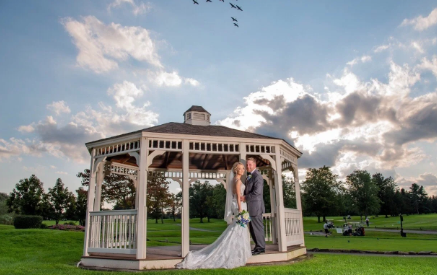
We have open grounds, a golf course, and a waterfront ceremony site — plenty of outdoor space for a dog at the ceremony and for photos. Ask us about the specifics for your day and we'll tell you exactly what works.
Frequently asked questions
Do Bucks County wedding venues allow dogs? Many allow dogs on the grounds and at outdoor ceremonies. Far fewer allow them indoors, largely because of health codes around food service.
Is there usually a fee for bringing a dog? Sometimes, or a refundable deposit. Some venues also require proof of vaccination or additional insurance. Ask when you book rather than close to the day.
Who should look after the dog during the wedding? Someone who isn't in the wedding party. A dedicated handler, or a professional pet attendant at roughly $150 to $400 for a few hours.
Should the dog stay for the reception? Usually not. Most dogs should leave after the ceremony and photos — a long reception with loud music isn't a good experience for them.
What do you need to bring? Water and a bowl, treats, waste bags, a towel, a spare leash, and something familiar. Plus a plan for who takes them home.
Should you rehearse? Yes, ideally at the venue. Dogs behave differently in unfamiliar places surrounded by strangers.
What if your dog isn't suited to it? A separate photo session beforehand is a genuinely good alternative — less stressful for the dog and usually better images, since there's no timeline pressure.
Last updated: August 2026